| HS Code | 483108 |
| Product | 58# Semi-Refined Paraffin Wax |
| Appearance | White crystalline solid |
| Meltingpoint C | 58 - 60 |
| Oilcontent | <= 1.0 |
| Sayboltcolor | +25 min |
| Needlepenetration 25c 1 10mm | <= 20 |
| Kinematicviscosity 100c Mm2 S | 5.0 - 8.0 |
| Flashpoint C | >= 200 |
| Watercontent | Absent |
| Mechanicalimpurities | Absent |
| Watersolubleacidsandalkalis | Absent |
| Odor | Odorless |
As an accredited 58# Semi‑Refined Paraffin Wax factory, we enforce strict quality protocols—every batch undergoes rigorous testing to ensure consistent efficacy and safety standards.
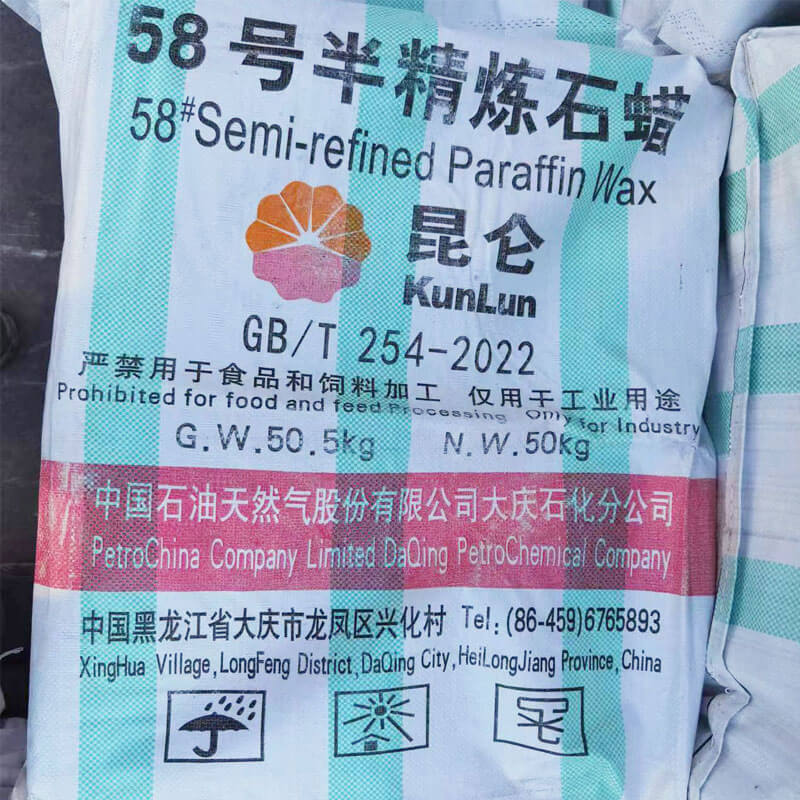
| Packing | 58# Semi-Refined Paraffin Wax supplied in sturdy 50 kg woven bags, palletized and wrapped for safe transport and storage. |
| Container Loading (20′ FCL) | Load 20′ FCL with palletized 58# semi-refined paraffin wax, evenly distributed and secured for safe transit. |
| Shipping | Ship 58# Semi-Refined Paraffin Wax as a non-hazardous solid, typically in molten tankers or as solidified slabs/pellets packed in woven bags, cartons, or palletized loads. Keep away from ignition sources, strong oxidizers, and excessive heat. Protect from contamination and moisture. Ensure proper labeling and documentation for safe handling and transport. |
| Storage | Store 58# Semi-Refined Paraffin Wax in a cool, dry, well-ventilated area away from direct sunlight, heat sources, and open flames. Keep containers tightly closed when not in use to prevent contamination. Maintain separation from strong oxidizers and incompatible materials. Avoid prolonged exposure to high temperatures, which may soften or degrade the wax. |
| Shelf Life | Shelf life is indefinite when stored in a cool, dry, well-ventilated area away from heat, sunlight, and contaminants. |
Molten 58# semi-refined paraffin wax at a metered pour temperature of 70–85°C functions as the continuous crystalline matrix in non-food molded candle manufacturing. A baseline container candle formulation comprises 70–85 wt% of the wax, 5–15 wt% stearic acid, 2–8 wt% microcrystalline wax, and 0.1–1.0 wt% polymeric additive to regulate shrinkage, opacity, surface finish, and release. Feedstock acceptance is controlled by ASTM D87 for melting point, with a 58°C cooling-curve inflection, ASTM D721 for oil content held at 1.5–2.0 wt%, and ASTM D1321 for needle penetration at 25°C in the 15–20 dmm range. Fire-safety compliance for the finished candle is assessed under ASTM F2417-17 and EN 15493:2019; REACH registration is mandatory for EU market placement. This material is not positioned as a direct food-contact grade, and candlemaking applications fall outside FDA 21 CFR food-contact jurisdiction.
On production lines, the wax is melted in steam-jacketed tanks and passed through 40 µm heated filters to remove charred particles before reaching servo-driven multi-nozzle filling machines. Molds are preheated to 35–45°C to minimize skinning at the fill front. The cooling rate is maintained between 0.5°C/min and 2.0°C/min in water-jacketed molds or forced-air tunnels; rates above 3.0°C/min generate center shrinkage voids and surface frosting because the paraffin network undergoes roughly 6–8% volumetric contraction during solidification. Demolding is scheduled at 20–40 minutes depending on diameter and overpour volume. Terminal finished goods produced from this route include container candles, pillar candles, votive candles, and candle melts; each product must satisfy wick-base temperature rise, secondary ignition, and stability criteria under the applicable fire-safety standard before release.
In wood composite manufacture, semi-refined 58# paraffin wax is delivered as an aqueous cationic emulsion and injected into the blowline to limit short-term water absorption and thickness swelling in medium-density fiberboard and particleboard. Addition levels are 0.5–1.5 wt% on dry fiber for MDF and 0.5–1.0 wt% for particleboard. Emulsion pH is held at 4.0–5.5; when pH rises above 8.0, cationic surfactant charge destabilization causes wax droplet coalescence, and a solid wax film deposits on blowline walls, deflector plates, and downstream drying cyclones. This failure produces boards with higher 24-hour water absorption, blocks dryer airflow, and requires unscheduled washdowns.
The emulsion is metered by a positive-displacement pump into the blowline at 160–180°C and 8–10 bar steam pressure, immediately after the defibrator disc and before the flash-tube dryer. Droplet diameters are typically 0.5–2.0 µm; because the droplets must survive high-shear steam flow without coalescence, the feed viscosity is maintained below 150 mPa·s at process temperature. Process staff monitor pH, conductivity, and solids in the day tank, as recycled white water from the dryer scrubber can introduce sodium or calcium ions that destabilize the emulsion. Regulatory compliance for the wax component follows REACH EC 1907/2006; the finished board is CE-marked under EN 13986 for construction use, and water resistance is characterized by EN 317:1993 thickness swelling after 24-hour immersion plus internal bond retention according to ASTM D1037-12.
Overfeed above 1.5 wt% is a recognized operational threshold: residual wax volatilizes in the dryer and condenses on cyclone walls, raising fire risk and creating a tacky deposit that disrupts wet fiber flow. At the lower boundary, below 0.5 wt%, thickness swelling control becomes inconsistent, particularly in high-density fiberboard exposed to humid-conditioning cycles. Published data for exact swelling reduction across specific board configurations is limited, but in-plant trials typically pair wax addition with the line’s resin system to avoid interference with melamine-urea-formaldehyde cure. Terminal products manufactured under this route include interior furniture panels, cabinet components, door cores, and flooring underlayment, where the wax is optimized to avoid excessive loss of paint adhesion or edge-glue bond strength.
| Standard | Measured parameter | Application context |
|---|---|---|
| ASTM D87 | Melting point by cooling curve | Wax feedstock specification |
| ASTM D721 | Oil content | Wax feedstock purity |
| EN 317:1993 | Thickness swelling after 24-hour water immersion | Particleboard / MDF |
| ISO 535:2014 | Cobb water absorption | Corrugated board |
| ASTM D1149-07(2012) | Ozone cracking resistance | Rubber compounds |
| ASTM D3236-15 | Hot melt viscosity | Adhesive systems |
For match splint impregnation, the absorption rate of semi-refined 58# paraffin wax determines whether the finished match burns evenly or exhibits premature flame collapse. Kiln-dried aspen or pine splints with 4–6% moisture content are conveyed through a molten wax bath at 110–140°C for 1–3 seconds, yielding a wax uptake of 2–4 wt% based on splint weight. Bath temperatures below 110°C raise melt viscosity and produce a non-uniform film that leaves the upper splint section unprotected during the transition from match head to wood flame; temperatures above 140°C promote thermal discoloration and increase free-oil migration. The wax bath is a hot-oil-jacketed stainless steel vessel equipped with an air knife to strip excess melt before the splints enter the head-dipping unit.
Splint moisture content functions as a critical threshold: above 8%, moisture vaporizes inside the molten wax and leaves pinholes; below 3%, capillary uptake becomes so rapid that trapped air creates an irregular internal wax channel. Either condition changes burn rate and can cause the splint to extinguish before the match head is fully consumed. Safety-match compliance is evaluated under EN 1783:1997, which includes afterglow and afterburn requirements; excessive wax uptake above 5 wt% has been observed to extend afterglow and may require reformulation of the head binder system. Finished products include safety matches, fireplace matches, and long-burn grill matches, where the wax film functions as a controlled combustion-extension layer rather than a decorative coating.
When semi-refined 58# paraffin wax is applied to corrugated medium by cascading or curtain coating, the production aim is to collapse the 60-second Cobb water absorption value to a level that permits wet produce or heavy industrial goods to be shipped without fiber failure. Applied dry coating weight ranges from 3–6 g/m² for light moisture resistance in outer cartons to 10–20 g/m² for waterproof industrial trays. The wax is held at 70–90°C and pumped to a curtain coater with a 0.5–1.0 mm slit; the corrugated sheet passes at 1.5–3.0 m/s through the falling melt curtain, then travels through a chilled-air section at 5–10°C to set the film within 15–30 seconds before stacking.
Water resistance is measured under ISO 535:2014 or TAPPI T 441 using a 60-second Cobb test; typical uncoated medium values of 120–160 g/m² are reduced below 30 g/m² at the upper coating weight, but actual values depend on sheet porosity, fiber furnish, and flute geometry. Medium porosity governs wax penetration: a Gurley porosity above 45 s/100 mL requires higher coating weight to achieve the same Cobb value, while low-porosity sheets may form surface-only films that crack on flexing. For regulatory compliance, the wax must meet REACH EC 1907/2006 registration in the EU; direct food-contact use under FDA 21 CFR 176.170 is not presumed for semi-refined material unless batch-specific migration and purity data demonstrate conformity.
Because the residual oil fraction in semi-refined wax can migrate into linerboard over prolonged storage, coating weights above 15 g/m² are typically restricted to single-service or short-cycle logistics applications where blocking and odor are not critical. Terminal products include export cartons, agricultural trays, humid-climate shipping containers, and non-food cold-chain boxes. In cascading systems, viscosity at constant bath temperature must be maintained within a ±10% band to avoid ribbon breakage, which creates uncoated lanes and accelerates local fiber failure under condensation conditions.
When semi-refined 58# paraffin wax is compounded into a diene rubber sidewall formulation, the functional requirement shifts from bulk-matrix reinforcement to controlled migration of a protective surface bloom. Addition levels are 1.0–3.0 phr, commonly split with 0.5–1.0 phr microcrystalline wax to tune the crystalline network and 1.0–2.0 phr of a p-phenylenediamine antiozonant. The wax dissolves in the rubber matrix during mixing at 140–160°C in an internal mixer with a 1.5–2.0 m³ chamber volume; after vulcanization at 150–170°C and subsequent cooling, the paraffin fraction migrates to the surface and forms a bloom film of approximately 0.5–1.0 µm thickness. Ozone resistance is evaluated under ASTM D1149-07(2012) or ISO 1431-1:2017, with first visible cracking time as the pass/fail criterion.
The bloom film must be replenished by reservoir wax below the surface; if the compound undergoes cyclic deformation, the film cracks and requires a rebloom period. In accelerated ozone testing at 50 pphm and 40°C, published data for this specific crude source varies; formulations with 2.0 phr semi-refined wax can extend first visible cracking beyond the wax-free control, but the numerical increment is polymer-system dependent. A lower-bloom-grade semi-refined wax with oil content above 2.0 wt% produces a tacky, uneven bloom that interferes with sidewall labeling and increases dirt pickup; fully refined waxes with narrow carbon distribution may bloom too slowly to provide protection during storage and shipping.
Processing limitations include reduced adhesion in white sidewall veneers and surface haze in high-gloss extruded profiles above 3.0 phr. Equipment includes tangential or intermeshing internal mixers, followed by open two-roll mills set at 50–60°C and strainer extruders for downstream calendering. Terminal products include tire sidewalls, conveyor belt covers, extruded rubber profiles, and antivibration components; in each case the paraffin bloom acts as a sacrificial ozone barrier that must be replenished by reservoir wax within the compound.
In EVA hot melt adhesive manufacture, semi-refined 58# paraffin wax operates as a crystalline diluent that reduces application viscosity and accelerates set time. Addition levels of 5–20 wt% are used in carton sealing and bookbinding adhesives, while APAO-based systems typically limit the wax fraction to 2–10 wt% to preserve elongation. The wax is charged with EVA, tackifier, and antioxidant into a molten mixer at 150–180°C under nitrogen blanketing; viscosity at 180°C is measured by ASTM D3236-15 or a Brookfield Thermosel, with slot-die application grades commonly adjusted between 800 and 1,500 mPa·s. Open time on board stock falls from approximately 8 seconds to below 2 seconds as wax loading rises from 5 wt% to 20 wt%.
Viscosity response to wax loading is nonlinear because the paraffin acts as a crystalline phase disruptor; the largest incremental drop occurs between 0 and 10 wt%, after which viscosity continues to fall at a reduced rate. Continuous heating above 180°C without a nitrogen purge accelerates oxidative degradation of the paraffin, increasing peroxide value and shifting viscosity by more than ±10% within four hours; this is a known pot-life limitation in open tank systems. For indirect food-contact packaging adhesive, the finished formulation is expected to meet FDA 21 CFR 175.105; semi-refined paraffin may be used only if the residual oil fraction and odor profile do not exceed the extraction limits of the specific packaging application. REACH registration for the wax remains mandatory for EU supplies.
Hot melt application equipment includes slot-die coaters, spiral spray nozzles, and wheel applicators operating at 160–190°C. Terminal product types include case and carton sealing adhesives, bookbinding primers, nonwoven hygiene construction adhesives, and edge-banding hot melts. In open tank systems, headspace oxygen content should be maintained below 5% to limit peroxide formation; wax batches with oil content near the upper specification limit are more prone to off-odor and color drift during prolonged hold times.
Competitive 58# Semi‑Refined Paraffin Wax prices that fit your budget—flexible terms and customized quotes for every order.
For samples, pricing, or more information, please contact us at +8618018036652 or mail to sales6@ascent-chem.com.
We will respond to you as soon as possible.
Tel: +8618018036652
Email: sales6@ascent-chem.com
Flexible payment, competitive price, premium service - Inquire now!
58# Semi-Refined Paraffin Wax is a medium-melting, solvent-deoiled petroleum wax identified by its nominal melting point of 58 °C. The material is produced from paraffinic distillate slack wax through methyl ethyl ketone–toluene solvent de-oiling and adsorptive clay finishing, leaving a controlled residual oil fraction that is intentionally higher than that of fully refined paraffin wax. Typical commercial release values for the 58# cut include a cooling-curve melting point of 58–60 °C (ASTM D87), oil content ≤ 1.5 % by mass (ASTM D721), Saybolt colour ≥ +25 (ASTM D156), needle penetration at 25 °C ≤ 20 1/10 mm (ASTM D1321), kinematic viscosity at 100 °C of 4.0–5.5 mm²/s (ASTM D445), and Cleveland open-cup flash point ≥ 220 °C (ASTM D92).
The 58# designation is a grade identifier, not a specification code; it signals the target melting-point plateau but does not by itself define oil content, colour, or oxidative stability. Purchase specifications therefore fix the residual oil limit and Saybolt colour as independent parameters, because adjacent refinery cuts such as 56# and 60# can be blended into the same nominal grade without changing the trade designation.
| Parameter | Unit | Typical commercial range | Test method |
|---|---|---|---|
| Melting point (cooling curve) | °C | 58–60 | ASTM D87 |
| Oil content | % by mass | ≤1.5 | ASTM D721 |
| Saybolt colour | Saybolt units | ≥+25 | ASTM D156 |
| Needle penetration at 25 °C | 1/10 mm | ≤20 | ASTM D1321 |
| Kinematic viscosity at 100 °C | mm²/s | 4.0–5.5 | ASTM D445 |
| Flash point (Cleveland open cup) | °C | ≥220 | ASTM D92 |
| Water content | % by mass | ≤0.1 | ASTM D95 |
The principal differentiation is residual oil content, colour stability, and odour profile. Fully refined 58 °C paraffin wax is hydrotreated or clay-treated to achieve lower oil, lighter colour, and lower odour; semi-refined material retains a controlled oil fraction that modifies crystallinity and cost. Slack wax, by contrast, is a high-oil feedstock that has not been de-oiled and is generally unsuitable for direct use in candle or hot-melt converting.
| Property | 58# semi-refined | Fully refined 58 °C cut | Slack wax | Test method |
|---|---|---|---|---|
| Residual oil content | 1.0–1.5 % by mass | ≤0.5 % by mass | 5–30 % by mass | ASTM D721 |
| Saybolt colour | ≥+25 | ≥+28 | +10 to +20 | ASTM D156 |
| Odour number | ≤2 | ≤1 | ≤3 | ASTM D1833 |
| Needle penetration at 25 °C | ≤20 1/10 mm | ≤20 1/10 mm | 30–80 1/10 mm | ASTM D1321 |
Compared with microcrystalline waxes, which contain substantially branched and cyclic hydrocarbons and typically exhibit needle penetration values above 25 1/10 mm, 58# semi-refined paraffin wax is a macrocrystalline wax with large, well-defined plate-like crystals. This crystal structure yields a sharper melt transition and lower melt viscosity; it also makes the material more brittle at low temperature. The semi-refined grade therefore acts as a stiffening or blocking additive in blends, whereas microcrystalline waxes contribute flexibility and adhesion.
Because the residual oil fraction acts as an internal plasticizer, the solid fracture behaviour of 58# semi-refined wax differs from a fully refined 58 °C cut. Fully refined material typically displays higher flexural stiffness and a sharper congealing transition, whereas the semi-refined grade releases from moulds more readily and can tolerate up to 3–5 % by mass of added microcrystalline wax without excessive surface haze. Oil migration can appear as surface gloss loss after storage at 35 °C or above; accelerated sweat-out testing for this specific grade should be validated against the actual storage profile.
For candle and match-splint production, 58# semi-refined paraffin wax is normally melted in steam-coil or hot-oil melters at 70–85 °C and transferred by jacketed gear pump at a discharge pressure of 0.5–1.0 MPa. In tea-light and container-fill formulations, stearic acid is co-blended at 3–8 % by mass to increase opacity and reduce centre-cone shrinkage. Residual oil levels above 1.5 % by mass increase the risk of visible smoke during open-flame burn; smoke is also influenced by wick strand diameter, wax-pool diameter, and pour temperature. Batch acceptance criteria include a ±1 °C melting-point window and a ±0.2 % oil-content window. For match-splint dipping, the wax is held at 75–80 °C in continuous dip tanks with scraped-wall heat exchangers; viscosity and film thickness are maintained by monitoring kinematic viscosity at 100 °C.
On corrugated board and paper-laminating lines, 58# semi-refined wax is applied as a hot-melt barrier using airless spraying, curtain coating, or roller coating at reservoir temperatures of 80–100 °C. At these temperatures, the typical 4.0–5.5 mm²/s kinematic viscosity at 100 °C (ASTM D445) is adequately low for atomization, but shear-rate dependence should be confirmed on the specific spray system. The residual oil in the semi-refined cut improves penetration into medium-density fibreboard and kraft liners, while excessive oil can reduce blocking resistance of stacked finished sheets. Water-vapour transmission rate on coated board is frequently tested to ASTM D1653 or TAPPI T448; published data for this exact grade in curtain coating is limited, so converters evaluate the wax on a pilot coater with a 30–50 g/m² dry coat-weight target.
In continuous molten-wax circuits, 58# semi-refined material is filtered through 50–100 µm stainless-steel basket strainers to remove carbon fines and clay carryover from the semi-refining process. Pressure drop across the filter normally remains below 20 kPa when the melt is held above 80 °C; higher pressure drop indicates wax-crystal agglomerates or water carryover. Water content above 0.1 % by mass causes foaming in melt tanks and pinholes in hot-melt coatings; a vacuum dewatering step is used when incoming water content approaches that limit.
In hot-melt adhesive compounding, 58# semi-refined paraffin wax is incorporated as a diluent and open-time regulator in ethylene-vinyl acetate (18–28 % vinyl acetate) and amorphous polyalphaolefin systems. Addition rates of 10–30 % by mass reduce melt viscosity at 180 °C to 1.0–2.5 Pa·s when measured by ASTM D3236. The residual oil plasticizes the ethylene-vinyl acetate phase and lowers tensile yield at room temperature, but improves wetting on polyethylene and polypropylene films. Because the oil is not chemically bound to the polymer network, adhesive storage above 40 °C can cause migration and loss of surface tack. Compatibility with butyl rubber and styrene-isoprene-styrene block copolymers is acceptable under melt compounding at 150–170 °C, but the semi-refined grade should not be selected where low volatile condensables are required, since the oil fraction increases headspace deposition on heated nozzle tips.
In rubber mixing, 58# semi-refined paraffin wax is added at 1.5–3.0 phr as an antiozonant protective film former. The residual oil fraction influences bloom rate: lower-oil grades bloom more slowly, while higher oil content produces a tackier surface film. The wax blooms to the rubber surface after vulcanization, and protective-film thickness is typically evaluated by visual comparison under 10× magnification after 72 h at 40 °C. Published data for this specific grade in tyre-sidewall compounds is limited; compounders validate ozone-protective film using ASTM D1149 or ISO 1431-1 at the specified ozone concentration.
Under EU REACH, petroleum waxes of CAS 8002-74-2 and EC 232-315-6 are registered as UVCB substances. The 58# semi-refined grade is subject to the registration dossier exposure scenarios, which typically include worker inhalation exposure limits for oil mist and mandate local exhaust ventilation in continuous tank rooms. The residual oil content generally excludes the product from direct food-contact use; fully refined 58 °C waxes are preferred where FDA 21 CFR 172.886 or 21 CFR 178.3710 compliance is required. Incoming QC release typically includes ASTM D87 melting point, ASTM D721 oil content, ASTM D156 Saybolt colour, ASTM D1321 needle penetration, and ASTM D445 kinematic viscosity. Acceptable lot-to-lot windows are commonly set at ±1 °C for melting point and ±0.2 % by mass for oil content. Low-level polynuclear aromatic hydrocarbon content is not routinely specified for non-food applications; for REACH compliance, the supplier’s safety data sheet must be reviewed for classification as CMR category 1A/1B under CLP. Published data for the 58# cut in specific food-contact configurations is limited.
Because 56# and 60# cuts are adjacent refinery fractions, uncontrolled blending can shift the 58# cooling curve by 1–2 °C without changing the product label. On automated pour lines using resistance-heated nozzles and reciprocating piston fillers, a lower melt point pours cleanly but produces softer pressed tablets; a higher melt point increases nozzle freeze-off and air entrapment. Molten wax held above 120 °C for more than 8 h can undergo thermo-oxidative colour drift, visible as Saybolt colour loss from +25 to +15 within a single shift if the tank is not inerted. Dry differential scanning calorimetry can be used to resolve melting-endotherm breadth; narrow cuts show an onset within 56–58 °C, while broad blends may extend the endotherm over 8–10 °C. Avoid combination with strong oxidizers and chlorinated paraffins in melt blends; these can accelerate acid evolution and darken the wax even under nitrogen. Storage in uncoated carbon steel at melt temperatures can promote iron pickup, so stainless-steel 304 or aluminium-coated tanks are used.