| HS Code | 370459 |
| Chemical Formula | (C3H6)n |
| Density 23 C | 0.90 g/cm³ |
| Melt Flow Rate 230c 2160g | 3.0 g/10 min |
| Tensile Strength At Yield | 36 MPa |
| Elongation At Yield | 12 % |
| Flexural Modulus | 1500 MPa |
| Izod Notched Impact Strength 23c | 45 J/m |
| Heat Deflection Temperature 0 45mpa | 90 °C |
| Vicat Softening Temperature | 152 °C |
| Melting Point Dsc | 162 °C |
| Rockwell Hardness | R-90 |
As an accredited Polypropylene Resin PP T30S factory, we enforce strict quality protocols—every batch undergoes rigorous testing to ensure consistent efficacy and safety standards.
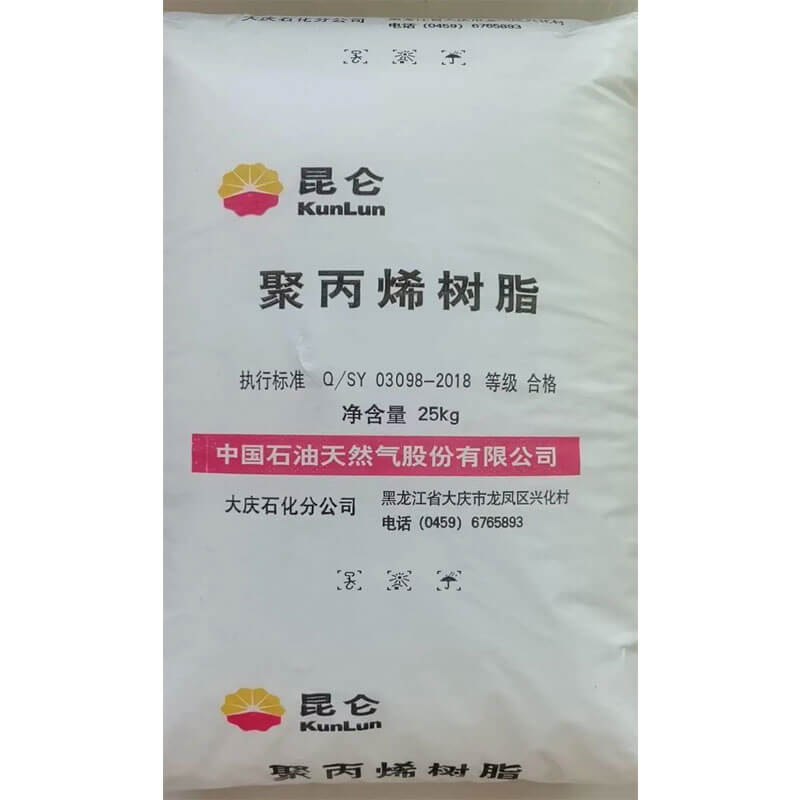
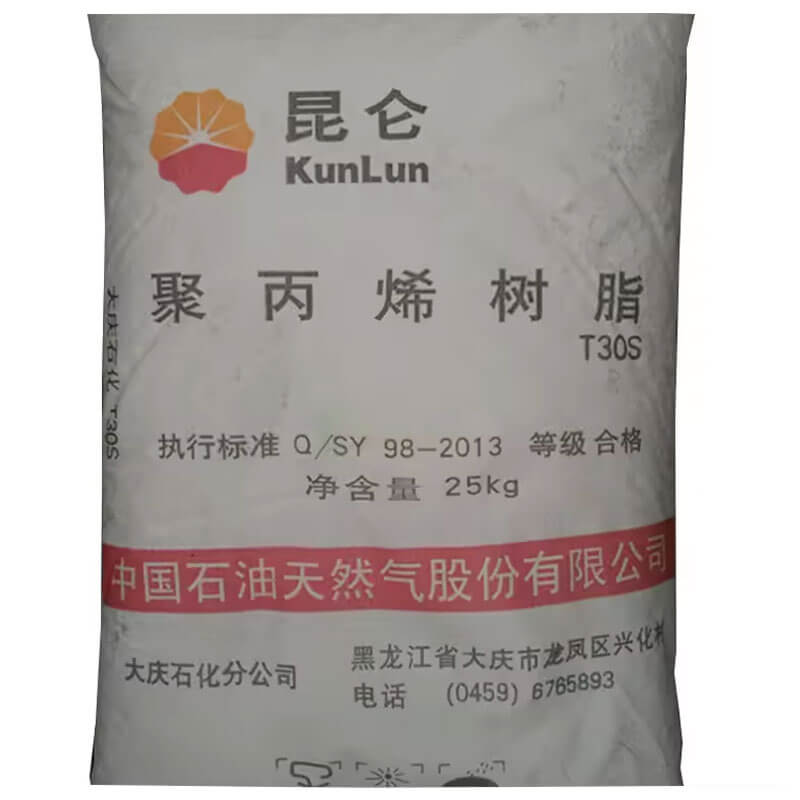
| Packing | Packaged in 25 kg woven polypropylene bags, palletized and shrink-wrapped for safe transport and storage. |
| Container Loading (20′ FCL) | Polypropylene Resin PP T30S packed in 25kg bags, stowed evenly in 20′ FCL, secured to prevent shifting. |
| Shipping | Polypropylene Resin PP T30S is typically shipped as non-hazardous plastic granules in 25kg woven PP bags, bulk bags, or powder/rail containers. Keep cargo dry, clean, and ventilated; avoid high heat and direct sunlight. No special DG restrictions, but proper stowage prevents contamination and bag damage during transit. |
| Storage | Store Polypropylene Resin PP T30S in a cool, dry, well-ventilated area away from direct sunlight, heat sources, and open flames. Keep packaging sealed and undamaged to prevent contamination and moisture pickup. Avoid dust accumulation and static discharge; ground equipment. Separate from strong oxidizers. Follow safe handling practices to preserve quality and prevent fire hazards. |
| Shelf Life | Shelf life is typically indefinite if stored in a cool, dry, shaded, well-ventilated area away from heat, moisture, and direct sunlight. |
Polypropylene Resin PP T30S is a homopolymer grade whose nominal melt flow rate is 3.0 g/10 min under ISO 1133-1:2022 at 230°C with 2.16 kg. The MFR position places the material at the lower end of the fluidity window for slit-film extrusion and injection moulding, where molecular weight sufficient for orientation-induced tenacity carries more weight than thin-wall filling capability. The following application scenarios are limited to downstream sectors in which T30S appears in converter bill-of-material records and production equipment audits; meltblown nonwovens, spunbond, and extrusion-coating lines are excluded because the grade’s MFR is incompatible with those processes without significant peroxide visbreaking.
| Property | Test method | Typical T30S range |
|---|---|---|
| Melt flow rate, 230°C, 2.16 kg | ISO 1133-1:2022 | 2.8–3.4 g/10 min |
| Density | ISO 1183-1:2019 | 0.90–0.91 g/cm³ |
| Tensile yield stress | ISO 527-2:2012 | 34–36 MPa |
| Flexural modulus | ISO 178:2019 | 1,450–1,650 MPa |
| Notched Izod impact, 23°C | ISO 180:2019 | 2.5–4.0 kJ/m² |
| Vicat softening temperature, VST/A50 | ISO 306:2022 | 155–158°C |
On production-scale tape extrusion equipment, T30S is fed neat from bulk silos into a single-screw extruder with 30:1–36:1 L/D and a barrier screw, with barrel set temperatures from 190°C in the feed zone to 240°C at the metering zone, then extruded through a flat die having 0.8–1.4 mm die gap. The melt curtain enters a water quench bath held at 30–40°C; quench temperature differential across the tape width above 5°C induces uneven crystallite size distribution and later denier fluctuation that cannot be corrected by draw ratio alone. After slitting to 2.0–4.0 mm wide tapes, the material is drawn through a hot-air oven at 110–125°C with draw ratio of 5.5:1–7.0:1, then annealed on heated godets at 85–95°C and wound onto caps. Lot-to-lot MFR drift between 2.8 g/10 min and 3.4 g/10 min under ISO 1133-1:2022 does not usually require barrel temperature adjustment; however, when MFR approaches 3.4 g/10 min, tape denier control on high-speed winders becomes sensitive to melt pressure fluctuation below 0.5 MPa. For 70–80 g/m² woven cement sacks, a typical dry-blend formulation is 93.0–96.0 wt% T30S, 2.0–5.0 wt% calcium carbonate masterbatch with 80% active filler, 1.0–2.0 wt% titanium dioxide/colour masterbatch, and 0.2–0.5 wt% HALS UV stabilizer when the sack is intended for outdoor storage. Filler addition above 8.0 wt% begins to reduce transverse tape tear strength in woven fabric; below 2.0 wt% provides little die-lip plate-out protection in slit-film extrusion. Finished woven sacks for food contact are evaluated under FDA 21 CFR 177.1520 for olefin polymers and (EU) No 10/2011 for plastic materials intended to come into contact with food; the specific migration of PP oligomers remains below the applicable overall migration limit only if the converter avoids recycled content. Industrial sack fabric tensile properties are characterised by ISO 13934-1:2013. Terminal finished product types include 50 kg cement sacks, fertiliser bags, sugar bags, and sand packaging.
Where the same T30S tape is converted into UN 13H2-coded flexible intermediate bulk containers, the extrusion step is only the first of a sequence in which seam strength, top-lift performance, and stacking endurance determine the value of the resin. Circular weaving of T30S tapes, typically 10 × 10 or 11 × 11 tapes per 25 mm, on six- or eight-shuttle circular looms produces tubular fabric. The fabric is coated or laminated with a polypropylene film layer where moisture barrier is required, then cut, gusseted, and sewn. Electrically conductive FIBC types require additional carbon-loaded tape insertion; T30S itself remains an electrical insulator with surface resistivity above 10¹² Ω unless treated. A weathering-resistant FIBC formulation for outdoor storage is 94.0–96.5 wt% T30S, 3.0–5.0 wt% calcium carbonate masterbatch, 0.3–0.6 wt% HALS/UV stabilizer masterbatch, and 0.5–1.5 wt% colour masterbatch. For food-contact FIBC used for sugar or starch, only food-approved masterbatch carriers are used, and the calcium carbonate loading is often reduced to 0–3.0 wt% to avoid dusting and sorption of product odours. Compliance for non-dangerous goods is addressed through ISO 21898; dangerous-goods FIBCs are certified under the UN Model Regulations, where design type tests include top lift, righting, drop, topple, and stacking. Tape breaks on circular looms occur most often when the hot-air oven temperature varies by more than ±5°C across the tape width; this creates local low-orientation zones with elongation at break above 25% that cannot be detected by denier alone. Finished product types include 500–1,250 kg bulk bags for minerals, grains, polymer pellets, and building chemicals.
In monofilament extrusion, water bath temperature is not a rinse condition but a quench-rate variable that fixes the initial crystallite size distribution before orientation. T30S exits a breaker plate/spinneret with hole diameters of 0.6–1.5 mm and enters a water quench at 30–38°C; at 38°C, surface quenching is slower, producing larger spherulites that can later be drawn to higher tenacity if the line uses two-stage orientation at 95–130°C in hot air or glycerin. Draw ratios between 6:1 and 9:1 are typical; above 9:1, T30S monofilaments show increased fibrillation at the circumference, especially with quench water temperatures below 30°C. For marine rope and agricultural twine, the formulation is 97.5–98.5 wt% T30S, 0.5–1.5 wt% black or colour masterbatch, and 0.3–0.6 wt% UV stabilizer masterbatch. Processing aids at 0.05–0.15 wt% are added only if the extruder head pressure exceeds 15 MPa; T30S lot-to-lot variation in MFR below 2.8 g/10 min raises head pressure and can reduce line speed. PP monofilament ropes are tested to ISO 1346:2012 for linear density, breaking force, and knotability. For food-contact netting, the finished article falls under FDA 21 CFR 177.1520 and (EU) No 10/2011; no heavy-metal-based pigments are permitted. Terminal finished product types include three-strand twisted ropes, braided cords, baler twine, and fishing net lines.
Injection moulding of T30S into returnable transit crates imposes contradictory requirements: wall thickness is minimised to reduce cycle time and polymer consumption, but the low MFR of 3.0 g/10 min limits flow length at a given gate size. Moulding trials on 500 tonne hydraulic injection machines with 45 mm screw and 20:1 L/D ratio use melt temperature 230–250°C, mould temperature 10–30°C, and injection pressure 90–130 MPa. Below 2.5 mm wall thickness, the short-shot risk rises unless the mould uses fan gates or multiple pin gates; flow-length-to-wall-thickness ratio is typically held below 150:1 for unreinforced T30S. A typical crate formulation is 98.5–99.5 wt% T30S, 0.10–0.30 wt% nucleating agent masterbatch, and 0.5–1.5 wt% colour masterbatch. The addition of nucleating agent raises crystallisation temperature from approximately 118–121°C to 128–130°C, shortening cycle time and increasing flexural modulus. Antistatic masterbatch at 1.0–2.0 wt% is added for electronics-compatible crates; however, antistatic packages containing ethoxylated amines can yellow after 6 months of UV exposure. Food-contact crates and pails are evaluated under FDA 21 CFR 177.1520(c) and (EU) No 10/2011; repeat-use articles are additionally assessed under Regulation (EC) 1935/2004 for overall migration and organoleptic transfer. Dimensional stability is measured by ISO 294-4:2018. Mould temperature differences above 10°C between core and cavity have been observed to increase corner warpage after demoulding; T30S parts with linear mould shrinkage of 1.2–1.8% per ISO 294-4:2018 may require cooling fixtures for 120–180 s. Finished product types include stackable beverage crates, fruit and vegetable crates, bakery trays, and industrial pails with lid seals.
Unlike slit-film tape for sacks, geotextile woven fabric is subjected to continuous horizontal and vertical loads in soil structures; the tape creep behaviour and long-term retained strength under confinement determine product quality. Woven geotextiles made from T30S tapes are produced by extruding flat tapes with 2.5–4.0 mm width, stretching them to 5:1–7:1, and weaving into plain-weave or twill structures on projectile or rapier looms. The fabric is stabilised by heat-setting at 80–100°C to reduce tape shrinkage. Outdoor geotextile grade uses 96.0–98.0 wt% T30S, 2.0–3.0 wt% carbon black masterbatch, and 0.3–0.6 wt% HALS/UV stabilizer. Calcium carbonate filler is restricted to 0–3.0 wt% because creep compliance under load increases with filler content. Geotextiles are specified by ISO 10319:2015 for wide-width tensile strength and elongation, ISO 12236:2010 for static puncture resistance, and ISO 13433:2010 for dynamic perforation cone drop. Carbon black dispersion in T30S geotextile tapes is a critical quality gate; poor dispersion produces local strength loss detectable as a broad tensile strength distribution with a coefficient of variation above 8% across fabric rolls. Terminal finished product types include road subgrade separation fabrics, coastal erosion control fabrics, landfill protection geotextiles, and ground stabilisation fabrics.
In tufted carpet secondary backing, T30S is extruded as a filled film or woven as primary backing tape, then laminated to the carpet backside on a hot-roll calender. The polymer melt is extruded through a slot die at 230–250°C and hauled onto a chill roll at 20–30°C; the melt film is drawn down to 0.10–0.25 mm thickness and nipped against the carpet back. Tuft lock retention is determined by the ability of the backing polymer to grip tufts without cracking after repeated flexing. Secondary backing compound may contain 20–40 wt% calcium carbonate masterbatch, with T30S as carrier; above 40 wt%, melt strength at the die lip is reduced and film edge stability declines. Primary woven backing from T30S tapes uses 5–10 wt% filler and 0.2–0.4 wt% antioxidant package to avoid discolouration during latex curing. Carpet flammability is assessed under 16 CFR 1630 and 16 CFR 1631 in the United States; unmodified T30S does not provide inherent flame resistance and requires FR-treated yarns or backcoating outside the resin pellet specification. Published data for T30S-specific carpet backing formulations is limited; filler loading is usually adjusted on the calender line through back-to-back trials because tuft lock retention is influenced by compound viscosity, film draw, and carpet fibre geometry. Terminal finished product types include residential and commercial tufted carpet rolls, automotive carpet mat backings, and carpet tiles.
Competitive Polypropylene Resin PP T30S prices that fit your budget—flexible terms and customized quotes for every order.
For samples, pricing, or more information, please contact us at +8618018036652 or mail to sales6@ascent-chem.com.
We will respond to you as soon as possible.
Tel: +8618018036652
Email: sales6@ascent-chem.com
Flexible payment, competitive price, premium service - Inquire now!
Polypropylene Resin PP T30S is a general-purpose isotactic homopolymer supplied in pellet form for extrusion and injection processes. The nominal melt mass-flow rate is 3.0 g/10 min at 230 °C under a 2.16 kg piston load determined in accordance with ISO 1133-1:2022. The resin is produced by Ziegler-Natta-catalysed bulk polymerisation and is characterised by a low xylene solubles fraction of ≤ 3.5 wt% under ISO 16152:2022, indicating high isotactic stereoregularity and crystallinity sufficient to produce a density of 0.90–0.91 g/cm³ by ISO 1183-1:2019. Because no ethylene comonomer is introduced, the mechanical profile is dominated by tensile stiffness and creep resistance rather than low-temperature impact resistance.
The grade is assigned primarily to oriented tape and multifilament lines producing woven sack fabric, baler twine, agricultural twine, and carpet backing. It is also processing-capable in thick-section injection molding, cast film, and compounding operations where low melt flow is required to preserve molecular weight and melt strength. The designation T30S is not a copolymer grade; it should not be substituted for random copolymers or heterophasic impact copolymers in applications requiring sub-zero impact resistance, optical clarity, or low seal-initiation temperature.
The melt mass-flow rate is the primary separator between this grade and high-speed injection or thermoforming products. At 2.5–3.5 g/10 min, the melt viscosity is high enough to maintain a stable neck during tape orientation but too low-flow for thin-wall containers with flow-length-to-wall-thickness ratios above 150:1. The isotactic fraction, measured as xylene solubles of ≤ 3.5 wt%, provides the crystalline structure necessary for rapid stockline crystallisation in water-quenched tape systems. A low ash content of ≤ 0.02 wt% under ISO 3451-1:2019 is specified to reduce abrasive wear on screw flights, barrels, and screen packs.
| Property | Test method | Typical value or criterion |
|---|---|---|
| Melt mass-flow rate at 230 °C, 2.16 kg | ISO 1133-1:2022 | 2.5–3.5 g/10 min |
| Density | ISO 1183-1:2019 | 0.90–0.91 g/cm³ |
| Tensile yield stress | ISO 527-2:2012, Type 1A, 50 mm/min | ≥ 31.0 MPa |
| Tensile elongation at break | ISO 527-2:2012, Type 1A, 50 mm/min | ≥ 500% |
| Flexural modulus | ISO 178:2019 | 1250–1450 MPa |
| Charpy notched impact at 23 °C | ISO 179-1/1eA | 2.0–4.0 kJ/m² |
| Heat deflection temperature at 0.45 MPa | ISO 75-2:2013, method B | 85–100 °C |
| Vicat softening temperature, A50 | ISO 306:2013 | 150–155 °C |
| Xylene solubles | ISO 16152:2022 | ≤ 3.5 wt% |
| Ash | ISO 3451-1:2019 | ≤ 0.02 wt% |
PP T30S is commonly supplied with a phenolic antioxidant/phosphite processing stabiliser package. It is not pre-stabilised for long-term ultraviolet exposure. Outdoor woven sacks therefore require a hindered amine light stabiliser masterbatch at 0.3–0.5 wt% and should be validated under ISO 4892-2:2013 for the target exposure class. This behaviour differs from agricultural film grades that already contain UV stabilisers and from white-pigmented grades that contain titanium dioxide screening. For food-contact applications, the base homopolymer is evaluated against 21 CFR 177.1520 and Commission Regulation (EU) No 10/2011; final compliance depends on the complete additive package and processing aids. Heavy-metal restrictions under RoHS 2011/65/EU remain applicable if colour masterbatch introduces prohibited cadmium, lead, or hexavalent chromium compounds.
The main differentiation of PP T30S is the absence of a dispersed ethylene-propylene rubber phase. Heterophasic impact copolymers with a comparable MFR show Charpy notched impact values of 8.0–10.0 kJ/m² at 23 °C under ISO 179-1/1eA, whereas PP T30S is typically 2.0–4.0 kJ/m². That lower impact value is not a processing defect but a design boundary for parts that must survive drop-impact tests such as ASTM D2463-15 for containers or ISO 6603-2:2000 puncture testing. The tensile yield stress of PP T30S is ≥ 31.0 MPa, which is above the 23–27 MPa yielded by many heterophasic impact grades; this explains the selection of T30S in woven sacks exposed to stacking loads and long-duration creep.
| Resin class | Typical MFR at 230 °C, 2.16 kg | Tensile yield stress | Flexural modulus | Charpy notched impact at 23 °C | Primary conversion process |
|---|---|---|---|---|---|
| PP T30S homopolymer | 2.5–3.5 g/10 min | ≥ 31.0 MPa | 1250–1450 MPa | 2.0–4.0 kJ/m² | Raffia tape, monofilament, cast film |
| High-flow injection homopolymer | 12–25 g/10 min | 33–36 MPa | 1350–1600 MPa | 2.0–3.5 kJ/m² | Thin-wall containers, closures, housewares |
| Heterophasic impact copolymer | 2.0–6.0 g/10 min | 23–27 MPa | 1000–1200 MPa | 8.0–10.0 kJ/m² | Automotive interior parts, luggage, crates |
| Random copolymer | 2.0–8.0 g/10 min | 24–28 MPa | 900–1100 MPa | 5.0–8.0 kJ/m² | Extruded sheet, blow molding, clear containers |
High-flow injection homopolymers with MFR between 12 g/10 min and 25 g/10 min exhibit lower melt viscosity and can fill wall sections below 1.0 mm at high injection speeds; however, the reduction in molecular weight depresses tensile elongation at break to 200–400% under ISO 527-2:2012 in some grades and makes them unsuitable for tape stretching where draw ratios exceed 5:1. PP T30S retains a higher oriented tenacity after stretching, which is why woven sack fabric and monofilament ropes are preferentially compounded from 2.5–3.5 g/10 min homopolymer rather than high-flow homopolymer or random copolymer.
On raffia tape lines, PP T30S is normally fed without crystallisation pre-treatment through a single-screw extruder with an L/D ratio of 30:1 to 40:1, a barrier screw with compression ratio of 2.5:1–3.5:1, and a 200–325 mesh screen pack. Barrel zone set points commonly begin at 180 °C in the feed section, rise to 230–240 °C in the compression and metering zones, and maintain a melt temperature of 235–245 °C at the die. A gear pump is set to maintain die pressure between 10 MPa and 18 MPa. If die pressure exceeds 20 MPa because of blocked screens or excessive melt viscosity, the resulting shear heating can raise melt temperature above 250 °C and cause chain scission. This presents as a drop in oriented tape tenacity below 25 cN/tex and an increase in flying waste at the stator bars.
The water-quench bath is maintained at 30–40 °C to control the formation of the crystalline skin-core morphology. During stretching, the first godet set is operated at 7–10 m/min, the draw ratio is held between 5:1 and 7:1, and the annealing godet is heated to 120 °C with 2–4% relaxation. Although polypropylene is not hygroscopic, pellet surface condensation can occur when silo storage is below dew point or when relative humidity exceeds 60%. Surface moisture introduced into the feed throat creates silver streak defects in tape and internal voids in drawn monofilament. A hot-air pre-drier at 80 °C for 2 h, or a vacuum hopper loader, is used when packaging is no longer intact or external pellets show visible dampness. This is an operational boundary rather than a requirement for molecular drying before every production campaign.
In cast film conversion, PP T30S can be extruded through a flat die with lip gap of 0.5–0.7 mm onto a chill roll maintained at 25–30 °C. Line speeds for 50 µm film are typically 60–120 m/min when a melt pump is used. Higher chill-roll temperatures reduce surface gloss by allowing spherulite growth; lower temperatures raise haze through micro-frost at the quench surface. The absence of ethylene comonomer means the resulting film has high stiffness but is not suitable for applications requiring low-temperature seal initiation below 140 °C in flexible packaging; random copolymer grades are used where seal initiation is specified by ASTM F88/F88M-21. PP T30S can also be processed into cast base sheet for subsequent orientation, but published data for high-speed biaxially oriented polypropylene processing of this specific grade is limited.
When PP T30S is injection molded into structural parts, the low MFR imposes higher barrel pressure than high-flow grades. A 40 mm reciprocating screw machine may operate at a barrel temperature profile of 200–240 °C from feed to nozzle, with a nozzle temperature of 235–250 °C. The injection pressure required for a flow-length-to-wall-thickness ratio above 150:1 may exceed 90 MPa; packing pressure is set at 50–70% of peak injection pressure. Mold temperature below 20 °C creates a quench-limited skin layer that reduces weld-line strength; mold temperature of 30–50 °C improves fusion at knit lines in thick-section parts. Vent depth must be limited to 0.02–0.03 mm to avoid flash, and the clamp force is calculated from the projected area and the packing pressure, not the peak injection pressure.
Regrind from tape edge trim or rejected parts may be reintroduced at up to 20 wt% in tape extrusion if the material is screened to 4.0 mm and blended with virgin resin at a constant ratio. Above 20 wt%, MFR drift and ash content may exceed the incoming lot tolerance, and screen-pack blinding frequency increases. A consistent regrind ratio is more important than bulk purity because batch-to-batch fluctuation in regrind level changes melt viscosity and tape gauge uniformity. If regrind contains oxidised gel particles from previous heat cycles, the melt filter must be maintained at 325 mesh or finer; otherwise, gel particles create weak points that reduce the tensile strength of oriented tape below specified minima.