| HS Code | 229615 |
| Cis 1 4 Content Percent | ≥96.0 |
| Trans 1 4 Content Percent | 2.0-4.0 |
| 1 2 Vinyl Content Percent | 1.0-2.0 |
| Mooney Viscosity Ml 1 4 At 100c | 45±5 |
| Density G Cm3 | 0.91 |
| Glass Transition Temperature Degc | -105 |
| Volatile Content Percent | ≤0.50 |
| Ash Content Percent | ≤0.20 |
| Organic Acid Content Percent | ≤0.20 |
| Soap Content Percent | ≤0.10 |
| Molecular Weight Distribution | medium |
| Color | white or light-colored |
As an accredited High‑cis‑Polybutadiene Rubber BR9000 factory, we enforce strict quality protocols—every batch undergoes rigorous testing to ensure consistent efficacy and safety standards.
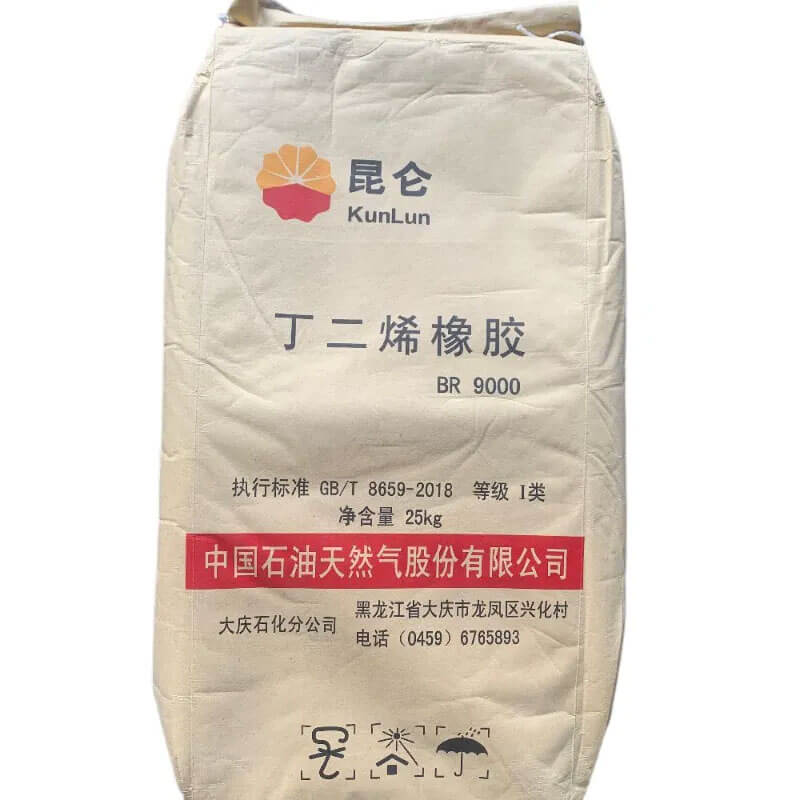
| Packing | High-cis-Polybutadiene Rubber BR9000 is supplied as 25 kg bales, wrapped in polyethylene film and packed on pallets. |
| Container Loading (20′ FCL) | High-cis-Polybutadiene Rubber BR9000 bales are packed tightly in 20′ FCL containers, secured and ventilated to prevent deformation and moisture damage. |
| Shipping | High-cis-Polybutadiene Rubber BR9000 ships as compressed bales wrapped in polyethylene film, often palletized. Store in a cool, dry, well-ventilated area away from sunlight, ozone, heat sources, and oxidizing agents. Protect packaging from moisture and physical damage during transport, and handle with clean equipment to prevent contamination. |
| Storage | Store High-cis-Polybutadiene Rubber BR9000 in a cool, dry, well-ventilated area, away from direct sunlight, heat, ozone, and strong oxidizing agents. Keep bales in original packaging on clean pallets, avoiding excessive stacking or compression. Maintain moderate humidity and protect from moisture to prevent degradation. Follow first-in, first-out inventory to ensure optimal shelf life. |
| Shelf Life | Shelf life is typically 2–3 years when stored in a cool, dry, dark, well-ventilated area, away from heat, oxygen, and direct sunlight. |
Partial substitution of E-SBR 1502 with BR9000 in a passenger radial tire tread cap compound is performed at 20–35 phr to shift the balance between wet grip, rolling resistance, and abrasion. The BR9000 bale is specified with cis-1,4 unit content at or above 96%, Mooney viscosity ML (1+4) 100 °C in the range 45±5, volatile matter no greater than 0.5%, and ash no greater than 0.1% according to the manufacturer quality certificate. The accompanying E-SBR or S-SBR polymer fraction is selected for styrene content 20–26% and vinyl content 8–12% when solution SBR is used; the resulting glass transition temperature of the cured compound is controlled by the concentration of those monomer units rather than by BR9000 itself. Carbon black N234 is charged at 65–75 phr together with TDAE oil at 30–37.5 phr, zinc oxide at 3.0 phr, stearic acid at 1.5 phr, 6PPD at 2.0 phr, microcrystalline wax at 1.0 phr, and TMQ at 0.5 phr. At this plasticizer level the compound remains below the threshold where BR9000 exudation and oxide bloom are observed on two-roll mill sheeting surfaces.
Mixing is run in a production-scale 270-L intermeshing internal mixer with two-wing rotors held between 35 min⁻¹ and 50 min⁻¹. BR9000 is charged first and masticated for 30–45 s before half of the carbon black and all oil are introduced; the remaining black is added after the first ram sweep. The non-productive batch is dropped at 150–160 °C and passed through a dump extruder or anti-tack batch-off unit. If dump temperature exceeds 165 °C, oxidative gel formation in BR9000 becomes measurable by an increase in black specks after finalization, and the batch is quarantined. A second non-productive pass is used only when filler macrodispersion rating under ISO 11345 requires additional work or when the compound Mooney viscosity exceeds 85 ML(1+4) 100 °C. The productive pass on an open mill at 35–45 °C incorporates sulfur at 1.4–1.8 phr, TBBS at 1.2–1.6 phr, and DPG at 0.2–0.5 phr. Curemeter testing under ISO 6502-3:2018 at 160 °C is used to target t90 between 3.5 min and 6.5 min; the value is lowered by increasing TBBS or reducing PVI, but scorch time tS2 below 1.5 min is unacceptable for downstream extrusion and tire-building operations.
Vulcanized sheets are press-cured at 150 °C for 15 min for tensile and tear testing. ISO 37:2024 Type 2 dumbbells are used for modulus and elongation; ISO 34-1:2022 for tear strength. Compared with an E-SBR-only control at equivalent hardness, the 25–30 phr BR9000 version typically increases rebound at 23 °C by 5–10 percentage points and reduces ISO 4649:2021 relative volume loss by 8–15%. Dynamic mechanical analysis at 10 Hz shows a 10–20% reduction in loss tangent at 60 °C, consistent with lower tire rolling resistance. Loading above 35 phr BR9000 is usually avoided in wet-grip-biased treads because the 0 °C loss tangent decreases beyond the tolerance band specified by the tire manufacturer; this is an intentional boundary rather than a compound failure.
Material-control tests applied to incoming BR9000 before compounding include:
| Property | Method | Specification/limit |
|---|---|---|
| cis-1,4 unit content | Manufacturer FTIR procedure aligned with ISO 12965:2006 | ≥ 96% |
| Mooney viscosity ML (1+4) 100 °C | ISO 289-1:2015 | 45±5 |
| Volatile matter | ISO 248-1:2021 | ≤ 0.5% |
| Ash | ISO 247-1:2018 | ≤ 0.1% |
| Specific gravity | ISO 2781:2018 | 0.90–0.91 |
In radial tire sidewall compounds, BR9000 is blended with natural rubber at 40–55 phr BR9000 and 45–60 phr NR to secure flex crack growth resistance and low-temperature flexibility without creating an unacceptable drop in green strength before assembly. The reinforcement system uses N330 or N550 carbon black at 45–55 phr; TDAE oil is restricted to 5–10 phr because higher oil addition accelerates both cut initiation under ISO 34-1:2022 and ozone crack development under static exposure. The protection package contains 6PPD at 3.0 phr, TMQ at 1.5 phr, and hydrocarbon wax at 1.5 phr; this combination is necessary because the BR9000 phase has lower inherent ozone resistance than the NR phase. A single non-productive pass in a 255-L tangential internal mixer is dropped between 130 °C and 145 °C, then curatives are added on a twin-roll mill at 45–55 °C using sulfur 1.0–1.4 phr, CBS 0.8–1.2 phr, and PVI 0.2–0.3 phr.
The upper limit of BR9000 is governed by fatigue and tear, not by mixing torque. At BR9000 loadings above 55 phr, DeMattia flex crack growth measured under ISO 132:2017 after 100,000 cycles commonly shows longer crack propagation than a 50 phr BR9000 compound at equal crosslink density. Tear strength by ISO 34-1:2022 die C can fall below 35 kN/m in the same high-BR region. Simultaneously, uncured sidewall compound with BR9000 above 55 phr shows necking and edge fracture on a pin-barrel extruder operating at 70–80 °C because green strength is insufficient to hold the profile dimension after the die. The lower limit, by contrast, is set by low-temperature performance: below 35 phr BR9000, the sidewall compound loses the desired flex fatigue life at -20 °C in OEM cyclic tests.
Cure is completed in a tire curing press at 160–170 °C for 8–12 min. The final BR9000-containing sidewall is subjected to ISO 132:2017 flex cracking and ISO 1431-1:2012 ozone resistance testing before tire assembly.
When BR9000 is selected as a secondary elastomer in abrasion-resistant conveyor belt cover stock, the cover compound is designed to pass DIN 22102-1 requirements for high-abrasion covers while retaining calender release on a four-roll S-configuration line. The polymer matrix comprises NR 40–50 phr, SBR1502 10–30 phr, and BR9000 25–40 phr. Carbon black N220 or N234 is added at 45–55 phr with TDAE oil at 5–8 phr; the cure system for high crosslink density uses sulfur 2.0–2.5 phr, CBS 1.0–1.4 phr, and TMTD 0.05–0.15 phr where fast aging-resistant cures are required. Mixing is performed in an 80-L intermeshing internal mixer; the batch is dropped at 135–145 °C and cooled to 90–110 °C on a warming mill before calendering.
At the calender, BR9000-containing stock is more sensitive to roll temperature than all-NR or all-SBR covers. Roll temperature is held at 70–85 °C with a friction ratio not exceeding 1:1.25; higher friction generates shear heating that initiates surface scorch before the cover reaches the friction-coating nip. The cover compound is vulcanized in a continuous Rotocure at 150–160 °C for 12–20 min, with dwell time adjusted to cover thickness between 6 mm and 12 mm. For Grade Y or W covers, ISO 14890:2021 requires tensile strength, elongation at break, and abrasion tests; ISO 4649:2021 relative volume loss is commonly held below 120 mm³ for high-abrasion grades and below 200 mm³ for general service covers. After heat ageing according to ISO 188:2011, BR9000 contributes to retained elongation at low temperature, but the high cis-1,4 content requires an antioxidant package containing 6PPD and TMQ to avoid surface degradation during outdoor storage of the finished belt.
Compression-molded solid industrial tires for forklifts and heavy-load trailers use BR9000 as a partial replacement for NR at 20–40 phr to reduce hysteresis heat generation under continuous cyclic deflection. The tread compound is built from NR 60–80 phr, BR9000 20–40 phr, N220 carbon black 45–60 phr, TDAE oil 5–10 phr, zinc oxide 5.0 phr, stearic acid 1.5 phr, 6PPD 2.0 phr, sulfur 1.2–1.8 phr, and TBBS 1.0–1.4 phr. Mixing in a 270-L internal mixer is dropped at 140–150 °C. The primary process conflict is heat history: the same low hysteresis that reduces service temperature also permits thicker uncured sections to reach full cure only when press curing is staged for long intervals, and any attempt to shorten cure by raising mold temperature above 155 °C risks scorch in BR9000-rich zones before the core reaches the target state.
Molding is performed in steam-heated hydraulic presses at 140–150 °C. Sections between 100 mm and 200 mm thick are cured for 4–6 h, with embedded thermocouple validation that the center has reached at least 135 °C and held for 30–60 min. At 30 phr BR9000, dynamic stiffness at 60 °C and 10 Hz measured by DMA is lower than in the all-NR control, which reduces heat build-up measured according to ISO 4666-1:2010 on a Goodrich flexometer. BR9000 above 50 phr is not used in this segment because the tensile modulus and die C tear strength become too low for severe cornering loads, and the risk of cord-band separation or shoulder chunking increases. The final product is a press-on solid tire bonded to a machined steel wheel band, inspected for internal voids by ultrasonic testing before dispatch.
Technical work footwear outsoles compounded with BR9000 at 20–30 phr are injection molded in an IR/NR/SBR matrix to achieve flex crack growth resistance below -20 °C and low density relative to solid rubber compounds. The polymer ratio is IR 40–50 phr, NR 10–20 phr, SBR1502 10–20 phr, and BR9000 20–30 phr. Precipitated silica at 35–45 phr with a bifunctional sulfur silane at 2.0–3.0 phr provides abrasion and wet-slip performance; zinc oxide 3.0 phr, stearic acid 1.0 phr, 6PPD or BHT 0.8–1.2 phr, sulfur 1.5–2.0 phr, TBBS 1.2–1.6 phr, and DPG 0.4–0.8 phr complete the system. Injection molding uses a reciprocating screw machine with barrel zones at 70–90 °C, back pressure 3–6 MPa, and mold temperature 160–175 °C; cure time ranges from 90 s to 180 s depending on outsole thickness and runner layout.
For safety footwear certified under ISO 20345:2021, the outsole compound is tested for abrasion by ISO 4649:2021 and flex cracking by ISO 17707:2005. Hydrolysis and fuel oil resistance are assessed by ISO 20344:2021. BR9000 contributes to retention of flex cracking after cold conditioning, but oil resistance is derived from the SBR and filler network rather than the BR9000 phase. The compounded stock is also subjected to a scorch check by ISO 6502-3:2018 at 120 °C to confirm that tS2 remains above 10 min, which is necessary for pause-free multi-cavity injection runs.
High-impact polystyrene reactors that adopt BR9000 as the rubber substrate dissolve the bales in styrene at 7–10 wt% before mass or mass-suspension polymerization. The high cis-1,4 structure and low vinyl concentration below 2% provide lower gel content than some emulsion rubber grades, but the solution viscosity at equal rubber content is higher. Dissolution is performed in a jacketed stirred vessel at 40–70 °C under nitrogen; the operator maintains agitation above 50 rpm to prevent rubber-rich sediment, while keeping a polymerization inhibitor such as 4-tert-butylcatechol at 10–30 ppm to prevent premature thermal polymerization. The rubber solution is then transferred to a prepolymerizer operating at 120–140 °C. Phase inversion occurs in the styrene conversion window of 10–15%; the shear rate in the prepolymerizer sets the rubber particle size distribution that later controls notched Izod impact, as tested by ASTM D256-23.
Published BR9000-specific HIPS grafting data is limited, and plant tuning is generally based on Mooney viscosity, solution viscosity, and microstructure rather than a fixed end-use impact guarantee. At rubber loadings above 9 wt%, prepolymerizer viscosity can exceed 500–1000 Pa·s at prevailing agitator shear rates, which may exceed torque limits on standard equipment and forces a reduction in throughput. The final pellet is characterized by melt flow rate under ISO 1133-1:2022 and notched Izod impact under ASTM D256-23. BR9000-derived rubber particles with low gel content are favored when consistent particle size distribution is required across batch-to-batch runs; however, grafting efficiency must be confirmed on a plant-specific basis because the low vinyl content may reduce the concentration of reactive crosslink sites available during phase inversion. Final HIPS pellets are used in appliance housings and electronic packaging where REACH and RoHS documentation is mandatory.
Competitive High‑cis‑Polybutadiene Rubber BR9000 prices that fit your budget—flexible terms and customized quotes for every order.
For samples, pricing, or more information, please contact us at +8618018036652 or mail to sales6@ascent-chem.com.
We will respond to you as soon as possible.
Tel: +8618018036652
Email: sales6@ascent-chem.com
Flexible payment, competitive price, premium service - Inquire now!
High-cis-polybutadiene rubber BR9000 is a stereoregular butadiene homopolymer supplied as pale bales. The product class is defined by a cis-1,4 microstructure target of not less than 96%, with the balance composed of trans-1,4 and vinyl-1,2 units. In compound development, BR9000 is evaluated as a blend component in tire treads, sidewalls, conveyor belt cover compounds, and high-impact industrial moldings where abrasion resistance, low-temperature flexibility, and dynamic crack growth are control properties. Lot acceptance is based on Mooney viscosity ML 1+4 at 100 °C under ASTM D1646-19a or ISO 289-1:2018, volatile content, ash residue, and microstructure. These parameters are not independent: a high Mooney lot raises mixer torque and compound viscosity, while a drop in cis-1,4 regularity reduces resilience and abrasion performance under DIN 53516.
Structurally, BR9000 belongs to the high-cis polybutadiene class, with cis-1,4 content typically reported between 96% and 98% depending on the manufacturer and catalyst package. The high cis fraction permits strain-induced crystallization at high elongation, but the crystallization rate and green strength are lower than natural rubber. In direct comparison, lithium-catalyzed polybutadiene is produced with cis-1,4 contents commonly between 35% and 45% and vinyl-1,2 contents of approximately 8% to 15%. The lithium grade has lower cold flow and better green strength in some operations, but its abrasion resistance and resilience are lower. Solution SBR introduces styrene and controlled vinyl units for wet grip and tread block stiffness, while BR9000 contributes a lower glass transition temperature and lower heat buildup. In a tire tread formulation, replacement of 20 to 30 phr of solution SBR with BR9000 typically reduces tan δ at 60 °C under dynamic mechanical analysis per ISO 4664-1 and reduces DIN 53516 abrasion loss. However, increasing BR9000 above approximately 40 phr in a precipitated-silica tire formulation can reduce tensile strength and tear resistance. Table 1 summarizes the comparative profile.
| Property | BR9000 high-cis BR | Li-catalyzed low-cis BR | Nd-catalyzed high-cis BR | Solution SBR reference |
|---|---|---|---|---|
| cis-1,4 content | 96–98% | 35–45% | 97–98.5% | 20–35% |
| vinyl-1,2 content | <1% | 8–15% | <0.5% | 20–50% |
| Glass transition temperature | −108 to −104 °C | −95 to −90 °C | −110 to −105 °C | −60 to −20 °C |
| Mooney viscosity ML 1+4 at 100 °C | 40–50 MU | 30–60 MU | 40–60 MU | 45–80 MU |
| Green strength | Low; lower than natural rubber | Moderate | Moderate | Moderate to high |
| Abrasion resistance | High | Low to moderate | High | Moderate |
The practical difference between BR9000 and natural rubber is most evident in tack and green strength. Natural rubber crystallizes rapidly under strain and maintains plied-sheet integrity, whereas BR9000 crystallizes only at high elongation and has lower room-temperature tack. That distinction becomes an advantage at low temperature: natural rubber stiffens below −50 °C, while BR9000 retains flexibility at approximately −70 °C. Within the high-cis BR family, neodymium-catalyzed grades may show lower gel content and lower long-chain branching than some nickel-catalyzed commodity grades, which can improve extrusion surface quality and fatigue life. Published data comparing BR9000 directly with every neodymium-catalyzed grade across all manufacturers is limited; users should run a reference compound with the actual lot rather than assuming equivalence.
The raw-polymer Mooney viscosity ML 1+4 at 100 °C is specified under ASTM D1646-19a or ISO 289-1:2018; a typical release window is 40 to 50 MU. The high-cis microstructure is determined by infrared spectrometry or 13C nuclear magnetic resonance; the cis-1,4 fraction is specified as ≥96%. Volatile matter is controlled to ≤0.5 mass % by ASTM D5668 or ISO 248, and ash content is controlled to ≤0.2 mass % by ASTM D5667 or ISO 247. The product is protected with a non-staining antioxidant; however, the exact stabilizer identity and loading are manufacturer-specific. For food-contact or medical applications, the stabilizer must be disclosed and checked against the relevant regulatory list. Table 2 lists the primary release parameters.
| Parameter | Method | Typical specification |
|---|---|---|
| Mooney viscosity ML 1+4 at 100 °C | ASTM D1646-19a, ISO 289-1:2018 | 40–50 MU |
| cis-1,4 content | IR, 13C NMR | ≥96% |
| Volatile matter | ASTM D5668, ISO 248 | ≤0.5 mass % |
| Ash | ASTM D5667, ISO 247 | ≤0.2 mass % |
| Glass transition temperature | ISO 22768 by DSC | −108 to −104 °C |
Compound vulcanizate properties are not fully fixed by raw-polymer specifications. Tensile strength, elongation at break, modulus, and tear resistance are influenced by filler loading, oil content, cure system, and mixing history. Published data for BR9000-specific compound performance in every end-use configuration is limited; a lot-specific reference compound should be prepared and tested under the relevant evaluation recipe, with tensile properties measured per ASTM D412 or ISO 37, tear resistance per ASTM D624 or ISO 34-1, and hardness per ASTM D2240 or ISO 48-4.
Processing behavior of BR9000 is governed by its low green strength, high cold flow, and relatively narrow shear thinning response. In an intermeshing internal mixer with a net chamber volume of 1.5 L for laboratory batches or 270 L for production-scale batches, the polymer is charged with carbon black, oil, and protective agents in the masterbatch stage. Ram pressure is initially reduced because the bale surface can slip on the rotor before filler incorporation. The masterbatch drop temperature is maintained between 145 °C and 160 °C; exceeding 170 °C in a sulfur-containing batch can initiate scorch on the subsequent mill. Rotor speeds of 35 min⁻¹ to 50 min⁻¹ are common, but the speed is raised or lowered as raw-polymer Mooney shifts. On a two-roll mill, roll temperatures are set between 40 °C and 60 °C. At roll temperatures above 80 °C, the band may lose cohesion and crumb. A lot shift from 40 MU to 50 MU can raise mixer torque and discharge temperature by several degrees, requiring a reduction in rotor speed or a delayed oil addition to avoid premature cure during mixing.
Extrusion of BR9000-containing profiles is generally performed on cold-feed pin-barrel extruders with a screw L/D ratio of 16:1 to 20:1. Die swell is lower than natural rubber, which improves dimensional stability in profile extrusion but reduces surface tack after hot-air vulcanization. Calendering of BR9000 as the sole rubber is difficult because of low green tack; a blend with 20 to 30 phr natural rubber or addition of a hydrocarbon tackifier is necessary for ply skim and gum calendering operations. The calendering line should maintain roll temperatures below 70 °C to avoid bagging and tack loss. In silica-filled tire tread formulations, BR9000 is mixed in a split cycle: the silanization stage is controlled at 140 °C to 150 °C, and the final curative stage is added on a mill below 100 °C. The low polarity of BR9000 reduces silane demand relative to solution SBR, but it also reduces filler-polymer interaction; silane dosage and mixing time must be rebalanced when BR9000 displaces a polar solution SBR fraction.
Vulcanization kinetics differ from natural rubber. BR9000 requires accelerator adjustment because the high cis-1,4 structure has lower crosslinking reactivity with certain sulfenamide systems. A conventional sulfur cure with 1.5 to 2.0 phr sulfur and 1.0 to 1.5 phr TBBS or CBS is a practical starting point; a semi-EV system may be used where lower compression set is required. Cure development is monitored by a moving-die rheometer under ASTM D5289-19a or ISO 6502-3:2018. In a 50/50 NR/BR9000 blend, the rheometer torque at t90 is typically shifted later than the corresponding NR control; the accelerator ratio is therefore adjusted rather than relying on the NR-only cure time.
BR9000 should not be specified as the sole polymer in applications requiring high green strength, such as hand-built tire plies or gum calender sheet, because bale cold flow and mill band edge tear are common at ambient temperatures above 35 °C. High-cis polybutadiene also has an unsaturated backbone and is not a barrier polymer; prolonged exposure to ozone or strong oxidizers requires antiozonant wax and p-phenylenediamine protection. It is not suitable for oil-resistant service because volume swell in mineral oil or reference fuel under ASTM D471 is significantly higher than nitrile rubber. In dynamic applications at continuous service temperatures above 90 °C, antioxidant protection and vulcanizate reversion resistance must be evaluated. Published data for BR9000-specific performance in oil-resistant seals or high-temperature automotive air ducts is limited; those applications require a saturated or polar polymer backbone rather than high-cis polybutadiene.